





文章目录
- Product Introduction: Honeysuckle
- Honeysuckle Product Line: Honeysuckle Powder, Honeysuckle Extract Concentrate, Honeysuckle Extract
- Processing and Preparation
- Medicinal Characteristics (Pharmacopoeia)
- Identification (Experience): Adulteration
- Identification: Pharmacopoeia
- Testing
- Content Determination and Fingerprint
- COA Analysis Report
- Major Chemical Components
- Effects and Uses
- Adverse Reactions and Contraindications
- Applications: Traditional Chinese Medicine, Health Foods, Foods
- Dosage and Administration
- Price
- Plant Description
- Growing Environment
- Distribution
- Harvesting and Processing
- Storage and Maintenance
- Literature Records
Product Introduction: Honeysuckle
Honeysuckle, also known as Lonicera japonica Thunb., is a traditional Chinese medicine used to clear heat and detoxify. The most suitable time to harvest is when the flower buds are swollen at the top, turning from green to white, and not yet fully open. Honeysuckle has a sweet and cold nature, and it acts on the lung, heart, and stomach meridians. It primarily clears heat, detoxifies, and disperses wind-heat. It is used for carbuncles, sore throats, erysipelas, heat-toxicity dysentery, wind-heat colds, and febrile diseases. Main chemical components include chlorogenic acid and isochlorogenic acid, volatile oils: caryophyllene, linalool, geraniol, octanal, and more than twenty other ingredients. Common dosage is 10–20g. It is widely used in pharmaceuticals, functional foods, and other industries.
Honeysuckle Product Line: Honeysuckle Powder, Honeysuckle Extract Concentrate, Honeysuckle Extract
- Honeysuckle Powder
- Honeysuckle Extract Concentrate
- Honeysuckle Extract:
Processing and Preparation
- Processing Methods:
- Raw Honeysuckle: Select raw material, remove stems, leaves, and impurities, and sift out debris. Raw honeysuckle is used to clear heat and detoxify and to dispel wind.
- Fried Honeysuckle: Place clean honeysuckle in a hot pan and stir-fry over low heat until yellow. Remove and cool. Fried honeysuckle is used to clear heat and release the exterior, and to harmonize the stomach and stop vomiting.
- Charred Honeysuckle: Clean honeysuckle, place in a pan, and stir-fry over medium heat until the surface is charred brown. Sprinkle with a little water to extinguish flames, dry thoroughly, and cool. Charred honeysuckle is used to clear heat, detoxify, and cool the blood.
- Characteristics of Prepared Honeysuckle:
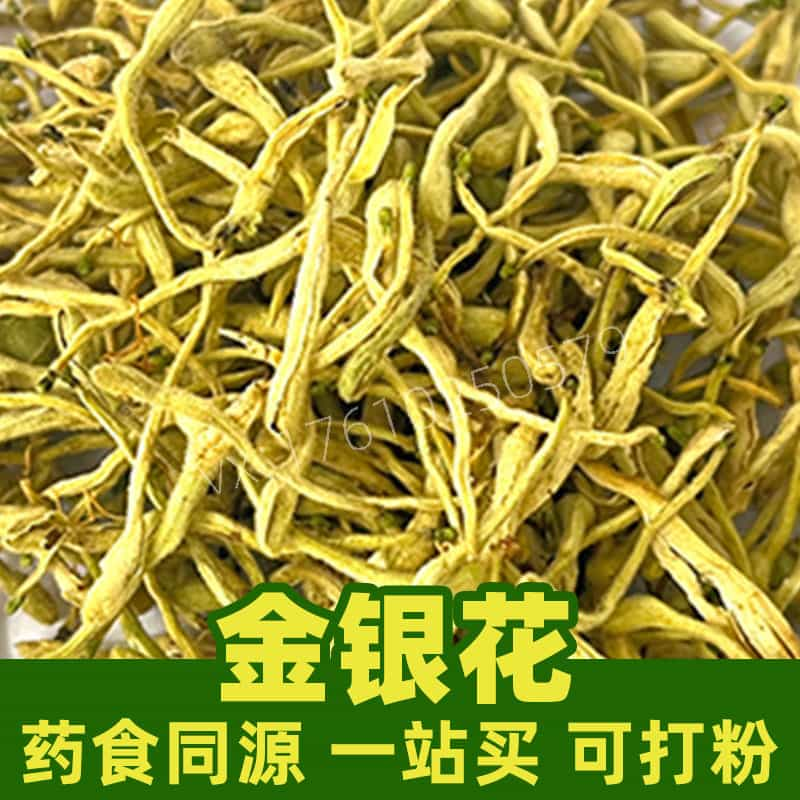
- Honeysuckle appears as curved sticks, 20–30mm long, thicker at the top and thinner at the bottom, yellow-white, green-white, or light yellow with short, soft hairs. The calyx is green. It has a clear, fragrant aroma and a slightly bitter taste. Fried honeysuckle is yellow. Charred honeysuckle is dark brown with a slight burnt odor.
Medicinal Characteristics (Pharmacopoeia)
The product is rod-shaped, thicker at the top and thinner at the bottom, slightly curved, 2–3cm long. The top diameter is about 3mm, and the bottom diameter is about 1.5mm. The surface is yellow-white or green-white (darkening with age), covered with short, soft hairs. Occasionally, leaf-like bracts are seen. The calyx is green, with 5 lobes at the tip, each lobe covered with hairs, about 2mm long. The open flowers have a tubular corolla with a two-lipped end; 5 stamens attached to the corolla wall, yellow; 1 pistil, with a hairless ovary. It has a clear fragrance, with a mild, slightly bitter taste.
Identification (Experience): Adulteration
Adulterated Honeysuckle
The fake honeysuckle has monotonous flower buds that are head-shaped or slightly short cylindrical. The leaf and net-veined honeysuckle buds are longer, about 7–8 cm, while the short-stemmed honeysuckle is only 1.1–2.1 cm long. The fake honeysuckle flowers are orange-yellow with a slightly reddish upper part, with a long, smooth tube and internal fine hairs; net-veined honeysuckle has a hairless style. The flower calyx is small, triangular, with short, rounded, needle-like teeth and hairy edges. It has a faint fragrance and a bitter taste.
Adulterated Honeysuckle.
The surface color is gray-yellow, with soft and swollen flower buds. Some flower buds are covered with a semi-transparent hard skin, making them brittle and easily broken, with a white fracture surface. It absorbs moisture easily, feels sticky and gritty, and makes a loud noise when dropped. It has an irritating smell and a salty, slightly astringent taste.
Identification: Pharmacopoeia
(1) The powder is light yellow-brown or yellow-green. Glandular hairs are numerous, with the head being inverted cone-shaped, round, or slightly oval, 4–33 cells, arranged in 2–4 layers, with a diameter of 30–64–108μm, and a stalk of 1–5 cells, up to 700μm long. Non-glandular hairs come in two types: thick-walled, single-celled, up to 900μm long, with fine wart-like or vesicular protrusions, some with a spiral pattern; and thin-walled, single-celled, very long, curved or wrinkled, with fine wart-like protrusions. Calcium oxalate clusters are 6–45μm in diameter. Pollen grains are round or triangular, with fine short spines and granular sculpturing on the surface, and 3 apertures.
(2) Take 0.2g of the powder, add 5ml methanol, let sit for 12 hours, filter, and use the filtrate as the test solution. Prepare a solution of chlorogenic acid reference standard in methanol to contain 1mg per ml, as the reference solution. Perform thin-layer chromatography (General Rule 0502) by spotting 10–20μl of the test solution and 10μl of the reference solution on the same silica gel H plate. Develop with the upper layer of a solution of butyl acetate-formic acid-water (7:2.5:2.5), dry, and examine under ultraviolet light (365nm). In the chromatogram of the test solution, there should be fluorescent spots in the same positions as those in the reference solution.
Testing
Moisture: Not more than 12.0% (General Rule 0832, method 4).
Total Ash: Not more than 10.0% (General Rule 2302).
Ash Insoluble in Acid: Not more than 3.0% (General Rule 2302).
Heavy Metals and Harmful Elements: Test for lead, cadmium, arsenic, mercury, and copper (using atomic absorption spectrophotometry or inductively coupled plasma mass spectrometry methods) with lead not exceeding 5mg/kg; cadmium not exceeding 1mg/kg; arsenic not exceeding 2mg/kg; mercury not exceeding 0.2mg/kg; copper not exceeding 20mg/kg.
Content Determination and Fingerprint
Determine by high-performance liquid chromatography (General Rule 0512).
Chromatographic conditions and system suitability test: Use 240nm as the detection wavelength; otherwise, conditions are the same as under [Content Determination] phenolic acids.
Preparation of reference solution: Accurately weigh a suitable amount of chlorogenic acid reference standard, dissolve in methanol to make a solution containing 0.40mg per ml.
Preparation of test solution: Same as under [Content Determination] phenolic acids.
Method: Precisely inject 2μl each of the reference and test solutions into the chromatograph and measure.
The test solution's chromatogram should show 7 characteristic peaks, with retention times of each peak relative to the S peak within ±10% of the specified values: 0.91 (Peak 1), 1.00 (Peak 2, S), 1.17 (Peak 3), 1.38 (Peak 4), 2.43 (Peak 5), 2.81 (Peak 6), 2.93 (Peak 7).
Phenolic Acids: Determine by high-performance liquid chromatography (General Rule 0512).
Chromatographic conditions and system suitability test: Use octadecyl silane-bonded silica as the packing; acetonitrile as mobile phase A, 0.1% phosphoric acid solution as mobile phase B, with gradient elution as specified; column temperature not exceeding 25°C; flow rate 0.7ml/min, detection wavelength at 327nm. Theoretical plate number for chlorogenic acid peak should not be less than 10000.
Preparation of reference solutions: Accurately weigh suitable amounts of chlorogenic acid, 3,5-di-O-caffeoylquinic acid, and 4,5-di-O-caffeoylquinic acid reference standards, dissolve in 75% methanol to make solutions containing 0.28mg, 0.15mg, and 44μg per ml respectively.
Preparation of test solution: Accurately weigh about 0.5g of powder (through a No. 4 sieve), place in a conical flask with 50ml of 75% methanol, weigh, sonicate (500W, 40kHz) for 30 minutes, cool, reweigh, and adjust to the original weight with 75% methanol, shake, filter, and use the filtrate.
Method: Precisely inject 10μl each of reference and test solutions into the chromatograph and measure.
The test product should contain not less than 1.5% chlorogenic acid (C(16)H(18)O(9)) and not less than 3.8% of total phenolic acids (chlorogenic acid, 3,5-di-O-caffeoylquinic acid, and 4,5-di-O-caffeoylquinic acid).
Luteoloside: Determine by high-performance liquid chromatography (General Rule 0512).
Chromatographic conditions and system suitability test: Use phenyl-silane-bonded silica (Agilent ZORBAX SB-phenyl 4.6mm × 250mm, 5μm) as packing; acetonitrile as mobile phase A, 0.5% ice acetic acid solution as mobile phase B, with gradient elution as specified; detection wavelength at 350nm. Theoretical plate number for luteoloside peak should not be less than 20000.
Preparation of reference solution: Accurately weigh luteoloside reference standard, dissolve in 70% ethanol to make a solution containing 40μg per ml.
Preparation of test solution: Accurately weigh about 2g of powder (through a No. 4 sieve), place in a conical flask with 50ml of 70% ethanol, weigh, sonicate (250W, 35kHz) for 1 hour, cool, reweigh, adjust to the original weight with 70% ethanol, shake, filter. Take 10ml of the filtrate, evaporate the solvent to dryness, dissolve the residue in 70% ethanol, transfer to a 5ml volumetric flask, and fill to the mark.
Method: Precisely inject 10μl each of reference and test solutions into the chromatograph and measure.
The test product should contain not less than 0.050% luteoloside (C(21)H(20)O(11)).
COA Analysis Report
Major Chemical Components
- Organic Acids
- Chlorogenic acid compounds are the main effective ingredients in honeysuckle, including chlorogenic acid and isochlorogenic acid, with isochlorogenic acid being a mixture. The content of organic acids in honeysuckle varies depending on its origin, variety, part, and harvest time.
- Chlorogenic Acid (C16H18O9): Molecular weight 354.30. The half-hydrate form is needle-like crystals (water), converting to the anhydrous form at 110°C. Melting point: 208°C. Solubility in water at 25°C is 4%, higher in hot water, easily soluble in ethanol and acetone, and slightly soluble in ethyl acetate.
- Flavonoids
- The earliest flavonoids extracted from honeysuckle include luteolin, with the next being rutin.
- Trace Elements
- Honeysuckle contains at least seven essential trace elements: manganese, chromium, nickel, copper, zinc, cobalt, and iron. It also includes essential major elements such as calcium, magnesium, sodium, and potassium. The content and types of trace elements in honeysuckle vary depending on the growing conditions and environment.
Effects and Uses
Adverse Reactions and Contraindications
Use with caution in individuals with spleen and stomach deficiency and those with ulcers of a yin nature.
Applications: Traditional Chinese Medicine, Health Foods, Foods
- Traditional Chinese Medicine: Honeysuckle granules, etc.
- Health Foods: Honeysuckle tablets and candies, etc.
- Foods: Honeysuckle tea, etc.
Dosage and Administration
- Oral Use: Decoction, 10–20g; or in pills or powders.
- Topical Use: Apply as needed, in a paste.
Price
Raw honeysuckle material price in Bozhou market: 150 RMB/kg.
For other specifications and prices, contact via WeChat for a quotation.
Plant Description
Honeysuckle, also known as silver flower, twin flower, winter honeysuckle, egret flower, or Erbao flower, is the flower bud of a perennial semi-evergreen climbing woody vine of the Caprifoliaceae family.
Honeysuckle is a semi-evergreen vine; young branches are dark reddish-brown and densely covered with yellow-brown, spreading, stiff hairs, glandular hairs, and short soft hairs, with the lower part often hairless. The leaves are papery, oval to broadly ovate, sometimes ovate-lanceolate, rarely round-ovate or inversely ovate, with few to several blunt notches, 3–5 (up to 9.5) cm long, with a pointed or gradually pointed tip, occasionally blunt, rounded, or slightly indented, and a rounded or nearly heart-shaped base with rough edge hairs. The upper side of the leaf is deep green, the underside is pale green, and the upper leaves on the young branches are usually densely covered with short rough hairs on both sides, while the lower leaves are often smooth and hairless, with a bluish-gray tint. Leaf stalks are 4–8 mm long and densely covered with short soft hairs. The flower stalks are usually solitary in the axils of the upper leaves, equal in length to or slightly shorter than the leaf stalks, with the lower ones up to 2–4 cm long, densely covered with short soft hairs and intermixed with glandular hairs. The bracts are large, leaf-like, oval to elliptical, up to 2–3 cm long, covered with short soft hairs on both sides or sometimes nearly hairless. The small bracts have a rounded or truncate apex, about 1 mm long, covering 1/2 to 4/5 of the calyx tube, with short rough hairs and glandular hairs. The calyx tube is about 2 mm long, hairless, with ovate triangular or long triangular teeth, with pointed tips and long hairs, and dense hairs on the outer surface and edges. The corolla is white, sometimes slightly reddish at the base, turning yellow later, 2–3 cm (up to 6 cm) long, with the tube slightly longer than the lip segments, rarely nearly equal in length, covered with somewhat downward spreading or half-spreading rough hairs and long glandular hairs, the upper lip segments are blunt at the tip, and the lower lip is strap-like and curved. The stamens and pistil protrude above the corolla. The fruit is round, 6–7 mm in diameter, turning glossy blue-black when ripe; seeds are oval or elliptical, brown, about 3 mm long, with a raised ridge in the middle and shallow transverse grooves on both sides. Flowering period is April to June (often flowering in autumn as well), and fruit ripens in October to November.
Growing Environment
Honeysuckle grows on hillside shrubs or sparse forests, rock piles, footpaths, and village fences, up to 1500 meters above sea level. It is also commonly cultivated.
Distribution
Honeysuckle is widely distributed in East China, Central and South China, Southwest China, as well as in Hebei, Shanxi, Liaoning, Shaanxi, and Gansu. In South China, it is found in Guangdong, Guangxi, and Hainan; in Zhejiang, Anhui, Fujian, Jiangxi, Hubei, Hunan, Guangdong, Guangxi, Sichuan, Guizhou, Yunnan, and Taiwan. It is known for its heat-clearing and detoxifying properties.
Harvesting and Processing
Honeysuckle flowers after 3–4 years of transplanting. Flowering time is concentrated and should be harvested in batches. Generally, the first harvest occurs in mid to late May, and the second in mid to late June. The optimal time to harvest is when the flower buds have swollen, turned white from green, and have not yet opened. After harvesting, honeysuckle should be dried or baked immediately to prevent mold and deterioration. During drying, avoid flipping to prevent blackening of the flowers. The drying temperature should be controlled: initial drying at 30–35°C for 2 hours, then increase to 40°C, drying for 5–10 hours, followed by maintaining room temperature at 45–50°C for 10 hours, then increase to 55–60°C to ensure rapid drying. Avoid flipping or halting drying before the flowers are fully dry. Baking yields higher quality and quantity than air drying.
Storage and Maintenance
Store in a dry container in a cool, dry place, protecting it from moisture and pests. Prevent rekindling of honeysuckle charcoal.
Literature Records
- “Ben Cao Zheng”: "Its nature is slightly cold and effective in detoxifying. Therefore, it treats boils, carbuncles, sores, and various toxins, including rheumatic toxins. It is indeed an essential medicine. It disperses undetermined toxins and helps to ulcerate established toxins. However, its action is slow; it should be used in higher doses or boiled with wine, or the juice mixed with wine for quick drinking, or ground and mixed with wine for thick application. For treating upper body wind and heat toxins, use about one or two liang, and regularly decoct it for best results."
- “Ben Cao Qiu Zhen”: "Honeysuckle is said in various books to replenish deficiency and nourish the blood, and to enter the lung and disperse heat. It can treat sores, diarrhea, boils, and hemorrhoids, being an important agent for external toxins. This seems contradictory. The explanation that it can replenish deficiency is due to its aromatic and sweet flavor, which, although it enters the body to drive away heat, does not cause significant harm; and its blood-nourishing effect is because it relieves toxic blood clots and thereby nourishes the blood. Ultimately, it is a heat-clearing and detoxifying product. Hence, for conditions like boils and sores, it is used internally for its cold and heat-clearing properties. Claims of prolonged use for longevity are not entirely exaggerated. Ancient records often describe medicinal effects in this manner, but users should be clear and not be misled by exaggerated claims."