







文章目录
- Product Introduction: Gastrodia elata
- Herb Characteristics (Pharmacopoeia) and Active Ingredients
- Identification of Gastrodia elata
- Medicinal and Dietary Uses of Gastrodia elata
- Usage Precautions for Gastrodia elata
- Introduction and Origin of Gastrodia elata
- Harvesting, Processing, and Storage of Gastrodia elata
Product Introduction: Gastrodia elata
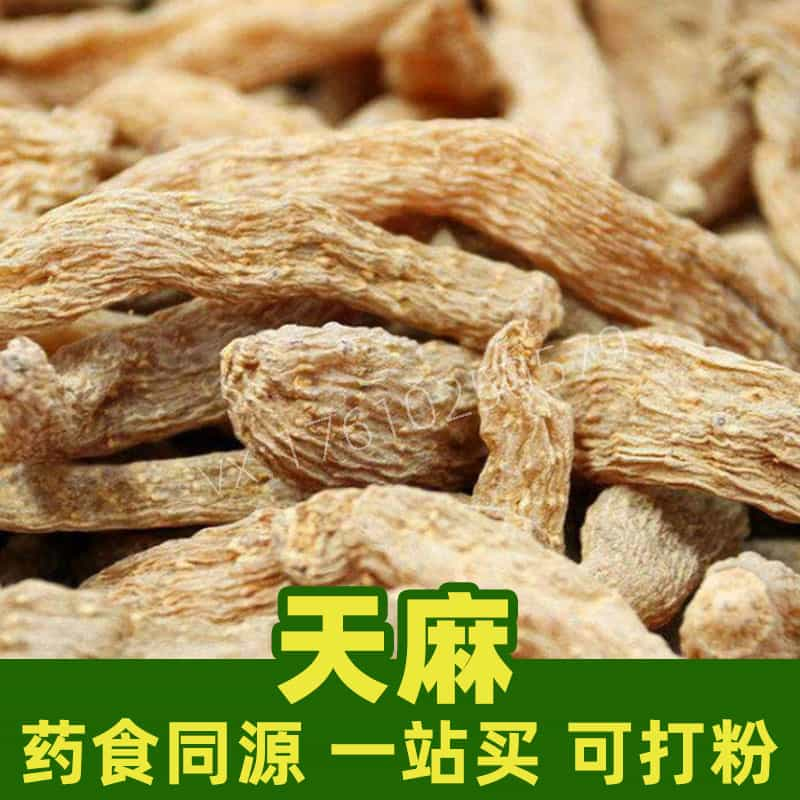
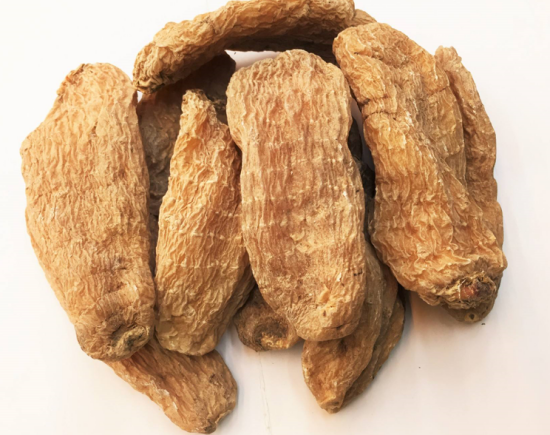
Gastrodia elata (Tianma), GASTRODIAE RHIZOMA, refers to the dried tuber of Gastrodia elata Bl., a plant in the Orchidaceae family. Harvested after the beginning of winter until before the Qingming Festival of the following year, it is immediately cleaned, fully steamed, and then air-dried at a low temperature.
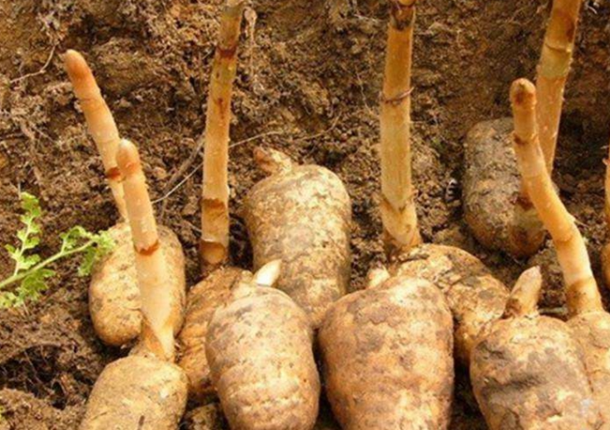
Below: Fresh and dried Gastrodia elata.


Red Gastrodia elata:
The plant is relatively tall, often reaching 1.5-2 meters; the rhizome is large, usually dumbbell-shaped, with a maximum weight of up to 1 kg and a water content of about 85%. The stem is orange-red, and the flowers are yellow with a slight orange-red hue. Flowering period is from April to May. Grown in provinces along the Yellow and Yangtze River basins. Red Gastrodia elata grows quickly, is highly adaptable, and is a high-yield variety, with a yield of over 10 kg per square meter, widely cultivated.

Green Gastrodia elata:
The plant is relatively tall, generally 1-1.5 meters; the rhizome is long and elliptical or inverted conical, with dense nodes and many scalelike sheaths on the nodes. The maximum single weight reaches 600 grams, with a water content of about 70%. The stem is light blue-green, and the flowers are light blue-green to white. Flowering period is from June to July. Grown in provinces from Northeast to Southwest China.

Black Gastrodia elata:
The plant is tall, 1.5-2 meters or more; the rhizome is oval to ovate-elliptical, with dense nodes, up to 15 cm or longer, and the maximum single weight is up to 800 grams, with a water content usually below 70%, sometimes only 60%. The stem is gray-brown with white vertical stripes, and the flowers are blue-green. Flowering period is from June to July. Grown in western Guizhou and northeastern to northwestern Yunnan.

Yellow Gastrodia elata:
The plant is over 1 meter tall; the rhizome is ovate-elliptical, with a maximum single weight of up to 500 grams and a water content of about 80%. The stem is pale yellow, and young stems are pale yellow-green. The flowers are pale yellow. Flowering period is from April to May. Grown in Henan, Hubei, western Guizhou, and northeastern Yunnan.

Hybrid of Yichang Red Gastrodia elata and Yunnan Black Gastrodia elata, combining the advantages of both parents: strong disease and pest resistance, wide temperature adaptability, good tuber morphology, high yield, with higher Gastrodin content than pure Black or Red Gastrodia elata, exceeding pure Red Gastrodia elata by more than double.

Herb Characteristics (Pharmacopoeia) and Active Ingredients
- Characteristics: This product is oval or long and slightly flat, wrinkled and slightly curved, 3-15 cm long, 1.5-6 cm wide, and 0.5-2 cm thick. The surface is yellow-white to yellow-brown, with vertical wrinkles and multiple transverse rings formed by the arrangement of latent buds, sometimes with brown fungal strands. The top end has a red-brown to dark brown beak-like bud or remaining stem base; the other end has a round navel-like scar. The texture is hard, not easy to break, the fracture is relatively flat, yellow-white to light brown, with a keratin-like appearance. It has a slight smell and sweet taste. When calculated as dry, the total content of Gastrodin (C13H18O7) and p-Hydroxybenzyl alcohol (C7H8O2) should not be less than 0.25%.
Gastrodia elata contains active ingredients such as Gastrodin, Gastrodigenin, β-Sitosterol, Carotenoid, Citric acid, Monomethyl ester, Palmitic acid, Succinic acid, Sucrose, Gastrodia polysaccharides, Vitamin A, various amino acids, trace alkaloids, and various trace elements like Chromium, Manganese, Iron, Cobalt, Nickel, Copper, Zinc, etc.
Identification of Gastrodia elata
- Identification points:
- "Parrot's Beak": The dried brown to dark brown beak-like bud at the top of the winter Gastrodia tuber, also known as "Red Braid".
- "Toad Skin": The latent bud and wrinkled surface of the Gastrodia medicinal material resemble the outer skin of a toad.
- "Belly Button": The round navel-like scar at the bottom of the Gastrodia, left after the mother tuber detaches, also called "Round Base".
- "Sesame Spots": The slightly raised buds on the surface of the Gastrodia medicinal material, arranged in discontinuous small dots forming transverse rings.
- "Ginger Skin": The surface of the Gastrodia tuber is gray-yellow or light brown, with vertical fine wrinkles resembling ginger skin.
Medicinal and Dietary Uses of Gastrodia elata
Gastrodia elata is sweet in taste, neutral in nature, and has the effects of calming wind, relieving spasms, suppressing liver Yang, and dispelling wind-dampness. It is mainly used to treat liver wind internal movement, convulsions, dizziness, headaches, limb numbness, hemiplegia, rheumatic pain, etc.
Common ways to consume Gastrodia elata:
- Gastrodia stewed chicken,
- Gastrodia pig brain porridge,
- Gastrodia braised oxtail,
- Gastrodia stewed turtle,
- Gastrodia and bamboo leaf porridge,
- Gastrodia and sliced meat soup,
- Gastrodia boiled eggs,
- Gastrodia and yam stewed pigeon,
- Gastrodia duck, etc.

Usage Precautions for Gastrodia elata
- Gastrodia elata should not be boiled for long periods. The main component, Gastrodin, easily volatilizes when exposed to heat. Boiling Gastrodia with other herbs can cause it to lose its sedative and analgesic effects. Therefore, it is best to soften Gastrodia with a small amount of water, slice it thinly, dry it, and grind it into powder. This powder can be taken with a pre-prepared herbal soup or used in pills.
- It should be used with caution in individuals with low body fluids, blood deficiency, or Yin deficiency. For those with liver Yang rising or phlegm obstructing the meridians, detailed diagnosis is necessary to achieve good therapeutic effects.
- Gastrodia elata should not be consumed alone. If used as a medicinal herb, it is best taken under the guidance of a professional doctor. If used in cooking, follow relevant recipes. It is important not to consume Gastrodia blindly, as it may lead to adverse effects.
- Do not consume Gastrodia for extended periods. According to "Compendium of Materia Medica," "Long-term use of Gastrodia leads to red rashes all over the body." Modern pharmacological experiments have shown that Gastrodia has certain toxic side effects. The toxic dose is over 40g, with a latency period of 1 to 6 hours. There have been reports of fatal arrhythmias caused by consuming large amounts of Gastrodia. Some patients may experience fever, dizziness, chest tightness, general numbness, nausea, vomiting, rapid breathing, urinary incontinence, itching, sweating, and confusion as side effects.
- Who should avoid Gastrodia: Generally, children and pregnant women should not consume Gastrodia. Nursing mothers and elderly, frail individuals should use it cautiously. Those with hot Bi syndrome, joint swelling, fever, dry mouth, and those with chronic diseases like hypertension, heart disease, and diabetes should follow medical advice for proper dosage.
Introduction and Origin of Gastrodia elata
Gastrodia elata is a perennial parasitic herb that grows 60-100 cm tall. The entire plant lacks chlorophyll. Its tubers are thick, fleshy, and oblong, measuring about 10 cm in length and 3-4.5 cm in diameter, with indistinct segments. The stem is cylindrical and yellowish-red. The leaves are scale-like, membranous, 1-2 cm long, with fine veins, and form a short sheath around the base of the stem. The terminal raceme is 10-30 cm long, with yellowish-red flowers. The flower stalk is short, measuring 2-3 mm. The bracts are membranous, narrowly lanceolate, or linear-elliptical, about 1 cm long. The perianth tube is crooked and urn-shaped, with a slanted opening and a slightly swollen base, ending in five small, triangular lobes. The lip is elevated two-thirds above the perianth tube, with three lobes; the central lobe is larger and forms a short stalk within the perianth tube. The column is 5-6 mm long, with two small appendages at the tip. The ovary is inverted-ovoid, with a twisted stalk. The capsule is oblong to oblong-inverted-ovoid, about 15 mm long, with a short stalk. The seeds are numerous, fine, and dust-like. Gastrodia elata blooms from June to July and bears fruit from July to August.
Gastrodia elata is mainly produced in Yunnan, Sichuan, and Guizhou. It is also distributed in Jilin, Liaoning, Hebei, Henan, Anhui, Hubei, Sichuan, Guizhou, Yunnan, Shaanxi, and Tibet.
Harvesting, Processing, and Storage of Gastrodia elata
Large white and arrow gastrodia planted for propagation can be harvested after one year, while small white and rice gastrodia require two years of cultivation before harvesting. Harvesting is usually done in early winter or early spring. The soil surface is first cleared to retrieve the fungal material, and the Gastrodia elata is collected and graded. Leaves are used to cover the gaps, allowing the rice gastrodia to continue growing. Arrow gastrodia, except for a portion kept for seed propagation, is processed into medicine along with white gastrodia. The processing method involves washing the graded Gastrodia elata, steaming them in a basket for 10-20 minutes until the center is no longer white, then drying them to remove moisture before further drying with fire until completely dry. If the tubers are large, they can be pierced with a needle to allow internal moisture to escape, pressed flat when semi-dry, left to sweat, and then dried at 70°C for 2-3 days until fully dried.
Store in a dry place to prevent mold and insect infestation.