








文章目录
- Product Overview: Reishi
- Reishi Product Series: Reishi Powder, Reishi Extract
- Processing and Slices
- Medicinal Material Characteristics (Pharmacopoeia)
- Product Specifications and Standards
- Identification (Practical): Fake Products
- Identification: Pharmacopoeia
- Inspection
- Content Determination and Fingerprint
- Effects and Uses
- Adverse Reactions and Contraindications
- Applications:
- Original Plant
- Growing Environment
- Distribution
- Harvesting and Processing
- Storage and Maintenance
Product Overview: Reishi
This product is the dried fruiting body of the fungi Ganoderma lucidum (Red Reishi) or Ganoderma sinense (Purple Reishi) from the Polyporaceae family. Harvested year-round, it is cleaned of impurities, trimmed of decayed wood, dirt, or substrate on the lower stem, and dried in the shade or at 40–50°C.
Main classifications include: Wild Reishi, Purple Reishi, Red Reishi, etc.
Reishi Product Series: Reishi Powder, Reishi Extract
- Reishi Powder:
- Reishi Extract Concentrate:
Processing and Slices
- Reishi Processing MethodsTake the raw material, remove impurities and wood chips, clean, and dry in the shade or at low temperatures.
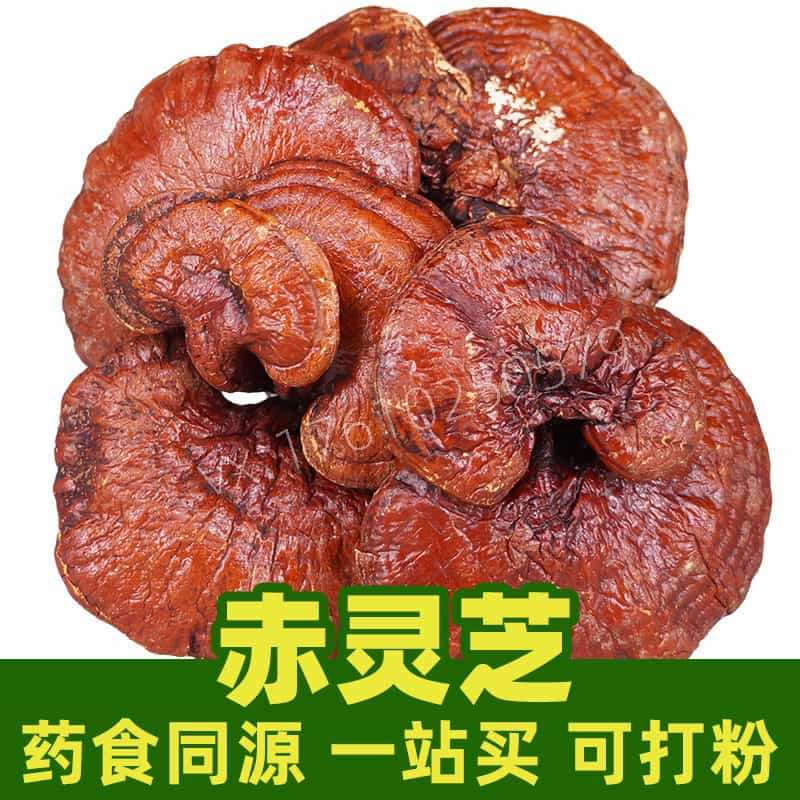
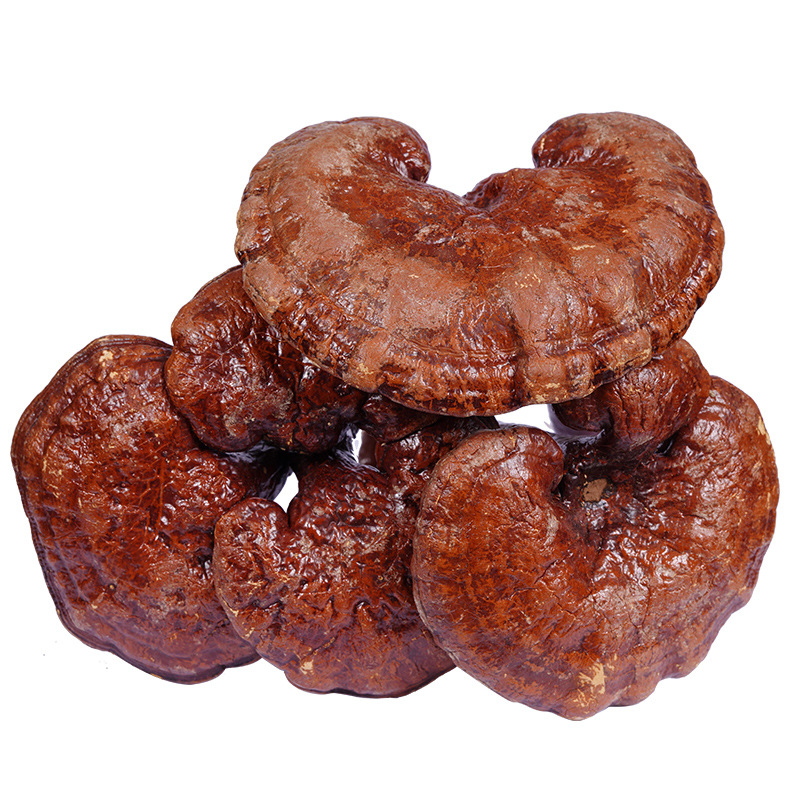
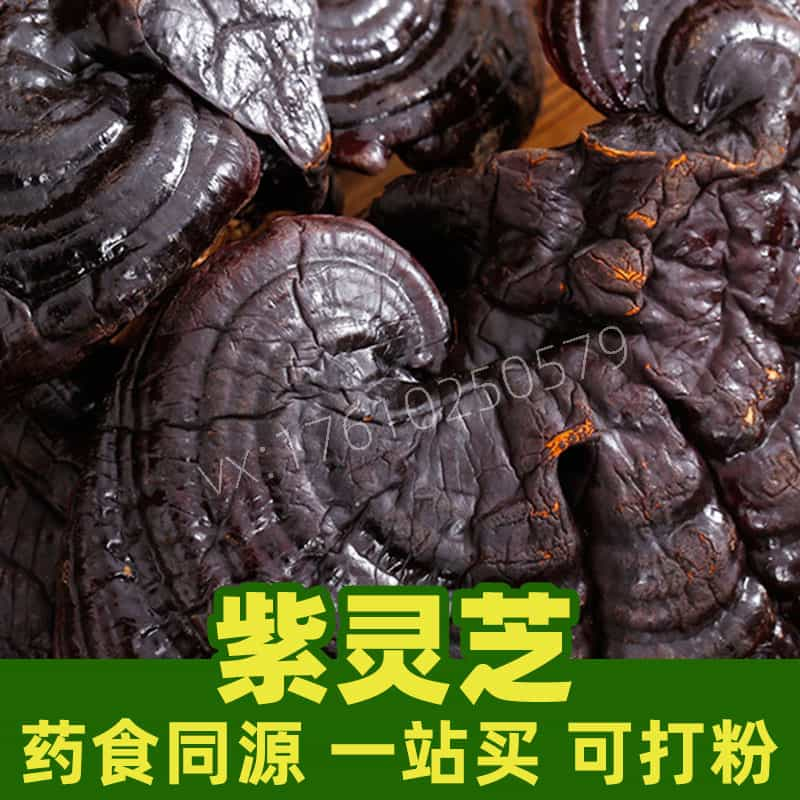
- Characteristics of Reishi SlicesThe cap is corky, semicircular, or kidney-shaped, with a lacquer-like sheen on the surface, reddish-brown, purplish-black, or brownish-black in color, featuring concentric ridges and radial wrinkles. The underside is visible with white, light brown, or rust-brown flesh. The lateral stem is glossy, reddish-brown, purplish-black, or black; spores are brown and oval. The texture is light, flexible, and tough. The aroma is faint, with a mild flavor.
Medicinal Material Characteristics (Pharmacopoeia)
Red Reishi
Shape is umbrella-like, with the cap kidney-shaped, semicircular, or nearly round, with a diameter of 10–18 cm and a thickness of 1–2 cm. The outer layer is hard, yellow-brown to red-brown, glossy, with ring-like ridges and radiating wrinkles. The edge is thin and flat, often slightly curled inward. The flesh is white to light brown. The stem is cylindrical, lateral or slightly off-center, 7–15 cm long, 1–3.5 cm in diameter, red-brown to purple-brown, shiny. Spores are tiny, yellow-brown. The scent is slightly aromatic, with a bitter and astringent taste.
Purple Reishi
The outer layer is purple-black with a lacquer-like gloss. The flesh is rusty brown. The stem is 17–23 cm long.
Cultivated Type
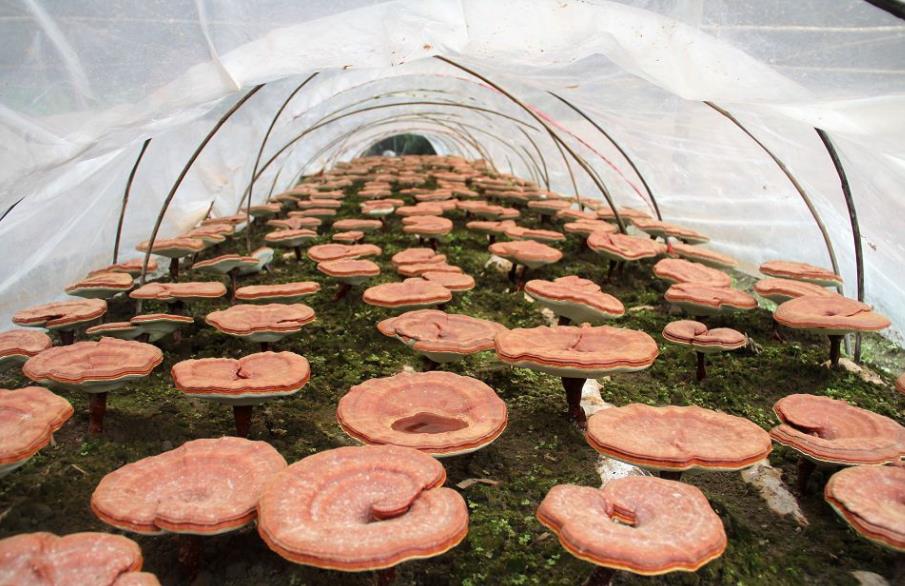
The fruiting bodies are relatively robust and thick, with a diameter of 12–22 cm and a thickness of 1.5–4 cm. The outer layer is often covered with a large amount of dust-like yellow-brown spores.
Product Specifications and Standards
Reishi Specification Levels
6.1 Original Material
This product is the dried fruiting body of Ganoderma lucidum (Leyss. Fr.) Karst. or Ganoderma sinense Zhao, Xu et Zhang, from the Polyporaceae family. Harvested throughout the year, impurities are removed, and the lower stem, which may be attached to decayed wood, sand, or growth medium, is trimmed. The product is air-dried or dried at 40–50°C.
6.2 Terms and Definitions
- Log Cultivation: Using broadleaf trees such as oak, sweetgum, and witch hazel, cut into specific-sized logs for reishi cultivation substrate.
- Substrate: Wood chips, wheat bran, and other materials mixed and processed to create a reishi cultivation substrate.
6.3 Specification Classification Criteria
Reishi medicinal material is categorized into "Red Reishi" and "Purple Reishi" based on the origin. It is further divided into "wild" and "cultivated" types based on growth conditions. Cultivated types are further classified into "log-based" and "substrate-based" types. Red Reishi is also categorized into "spore-bearing" and "non-spore-bearing" types based on harvest time. Log-based, non-spore-bearing Red Reishi is classified into superior and first-grade; other specifications fall under general grade.
6.4 Specification Standards
Refer to the table for Reishi product specification standards.
6.5 Points to Note in Specification Classification
- Be aware of other Polyporaceae like tree ears, which are often confused with reishi.
- Most reishi on the market is spore powder; the time of spore discharge varies. True non-spore-bearing reishi is rare.
- Some reishi is steamed before drying for storage and pest control, which does not meet the "China Pharmacopoeia" requirements for air-drying or drying at 40–50°C.
- There are instances of cultivated reishi with smaller, irregular shapes being sold as wild reishi.
Identification (Practical): Fake Products
True Reishi vs. Fake Reishi
Wild Reishi vs. Cultivated Ginseng
Identification: Pharmacopoeia
- The powder is light brown, brown, or purple-brown. Mycelium is dispersed or clumped, colorless or light brown, elongated, slightly curved, branched, with a diameter of 2.5–6.5 μm. Spores are brown, oval, with flat tops, colorless outer walls, and warty protrusions on the inner wall, 8–12 μm long and 5–8 μm wide.
- Take 2 g of the powder, add 30 ml of ethanol, heat under reflux for 30 minutes, filter, evaporate the filtrate to dryness, dissolve the residue in 2 ml of methanol as the test solution. Prepare a reference solution using 2 g of reishi material by the same method. Perform thin-layer chromatography (TLC) using petroleum ether (60–90°C)-ethyl acetate-formic acid (15:5:1) as the mobile phase. Develop, dry, and examine under UV light (365 nm). Compare the fluorescence spots of the test solution with those of the reference material.
- Take 1 g of the powder, add 50 ml of water, heat under reflux for 1 hour, filter while hot. Place the filtrate in an evaporating dish, wash the container with a small amount of water, combine the washings, evaporate to dryness, dissolve the residue in 5 ml of water, add 25 ml of ethanol slowly with stirring, let sit for 1 hour, centrifuge at 4000 rpm. Wash the precipitate with 10 ml of ethanol, centrifuge, dry, and cool. Add 2 ml of 4 mol/L trifluoroacetic acid solution to a 10 ml ampoule or headspace vial, seal, mix, hydrolyze at 120°C for 3 hours, cool, transfer the hydrolysate to a 50 ml flask, wash the container with 2 ml of water, add to the flask, evaporate under reduced pressure at 60°C, dissolve in 2 ml of 70% ethanol, centrifuge, and use the supernatant as the test solution. Prepare reference solutions with galactose, glucose, mannose, and xylose in 70% ethanol to a concentration of 0.1 mg/ml. Perform TLC using n-butanol-acetone-water (5:1:1) as the mobile phase. Develop, dry, spray with p-aminobenzoic acid solution, heat at 105°C for about 10 minutes, and examine under UV light (365 nm). Compare the fluorescence spots with the reference.
Inspection
- Moisture: Not more than 17.0% (Method 0832, Second Method).
- Total Ash: Not more than 3.2% (Method 2302).
Content Determination and Fingerprint
- Preparation of Polysaccharide Reference Solution: Take an appropriate amount of anhydrous glucose reference, weigh precisely, and dissolve in water to make a solution with a concentration of 0.12 mg/ml.
- Standard Curve Preparation: Measure 0.2 ml, 0.4 ml, 0.6 ml, 0.8 ml, 1.0 ml, and 1.2 ml of the reference solution, place in 10 ml test tubes, add water to 2.0 ml, quickly add 6 ml of sulfuric acid anhydride solution, mix immediately, let sit for 15 minutes, then cool in an ice bath for 15 minutes. Measure absorbance at 625 nm using UV-visible spectrophotometry, plot absorbance versus concentration to create the standard curve.
- Preparation of Test Solution: Take about 2 g of the powder, weigh precisely, place in a round-bottom flask, add 60 ml of water, let sit for 1 hour, reflux for 4 hours, filter while hot, wash the filter and residue with hot water, combine the filtrate, evaporate to dryness, dissolve the residue in 5 ml of water, slowly add 75 ml of ethanol while stirring, let sit at 4°C for 12 hours, centrifuge, discard the supernatant, dissolve the precipitate in hot water, transfer to a 50 ml volumetric flask, cool, add water to the mark, mix, and use as the test solution.
- Determination: Measure 2 ml of the test solution, place in a 10 ml test tube, and follow the standard curve preparation method from "quickly add sulfuric acid anhydride solution" onward. Measure absorbance and read the content of anhydrous glucose from the standard curve. The product should contain not less than 0.90% polysaccharides based on dry weight.
- Triterpenes and Sterols:
- Preparation of Reference Solution: Take an appropriate amount of lucidenic acid reference, weigh precisely, and dissolve in methanol to make a solution with a concentration of 0.2 mg/ml.
- Standard Curve Preparation: Measure 0.1 ml, 0.2 ml, 0.3 ml, 0.4 ml, and 0.5 ml of the reference solution, place in 15 ml test tubes, evaporate, cool, add 0.2 ml of freshly prepared vanillin-acetic acid solution, and 0.8 ml of perchloric acid. Mix, heat in a 70°C water bath for 15 minutes, cool in an ice bath for 5 minutes, add 4 ml of ethyl acetate, mix, and measure absorbance at 546 nm using UV-visible spectrophotometry. Plot absorbance versus concentration to create the standard curve.
- Preparation of Test Solution: Take about 2 g of the powder, weigh precisely, place in a flask, add 50 ml of ethanol, and perform ultrasonic treatment (140 W, 42 kHz) for 45 minutes, filter, transfer the filtrate to a 100 ml volumetric flask, wash the filter and residue with ethanol, combine the washes, add ethanol to the
Effects and Uses
Ganoderma is a traditional Chinese medicine known for its tonic and strengthening properties, used to enhance health and vitality.
Adverse Reactions and Contraindications
- Avoid use in those with acute symptoms or initial external infections.
- Ganoderma is a potent platelet aggregation inhibitor, so caution is advised for those with bleeding disorders or tendencies.
- Use with caution in individuals with allergies.
- According to the "Compendium of Materia Medica," it is advised to avoid combining Ganoderma with certain herbs.
- Modern pharmacological research indicates...
Applications:
Traditional Chinese Medicine, Health Foods, Foods
- Traditional Chinese Medicine: Ganoderma longevity capsules, Ganoderma syrup, Ganoderma slices, etc.
- Health Foods: Ganoderma spore powder.
- Foods: Ganoderma tea.
Original Plant
- Ganoderma: A single-year fruiting body with a stalk, corky. The cap is semicircular or kidney-shaped, 10-20 cm in diameter, with a thickness of 1.5-2 cm. The cap surface is brownish-yellow or reddish-brown, with gradually fading yellow edges, concentric rings, slightly wrinkled or smooth, with a glossy varnish-like sheen, and a slightly blunt edge. The flesh is milky white, becoming light brown near the tubes. The tubes can be up to 1 cm long, with 4-5 pores per mm. The pore openings are nearly round, initially white, turning light yellow or yellow-brown. The stalk is cylindrical, lateral or slightly off-center, occasionally central. It is 10-19 cm long, 1.5-4 cm thick, and similar in color to the cap. The hymenium is rod-shaped, with an expanded top. The mycelium system has three types: reproductive mycelium is transparent and thin-walled; skeletal mycelium is yellow-brown, thick-walled, and almost solid; and the winding mycelium is colorless, thick-walled, curved, and evenly branched. Spores are oval, with a double wall, a flat-topped apex, transparent outer wall, and light brown inner wall with small spines, size (9-11) μm × (6-7) μm. The fruiting body matures in the fall, extending to winter in South China and the Southwest.
- Purple Ganoderma: Different from the previous type, the cap is often dark purple to nearly black; the flesh is uniform brown, deep brown to chestnut brown; spores have a pronounced umbilicus at the apex, with prominent spines on the inner wall. Spores are larger, size (9.5-13.8) μm × (6.9-8.5) μm.
Growing Environment
Grows on hardwood stumps or roots of oak, beech, and other broad-leaved trees, or on conifers like hemlock. Ganoderma fungi mostly thrive in areas with scattered sunlight and sparse trees or open spaces.
Distribution
Ganoderma is found on all continents, with the majority growing in tropical, subtropical, and temperate regions. In China, Ganoderma fungi are widely distributed, with major locations including Beijing, Hebei, Shandong, Jiangsu, Zhejiang, Fujian, Jiangxi, Hubei, Hunan, Guangxi, Guangdong, Henan, Yunnan, Sichuan, Guizhou, Hainan, Taiwan, Shaanxi, Shanxi, Anhui, Gansu, Tibet, and Hong Kong.
Harvesting and Processing
Harvested year-round. Remove impurities, screen out sand and soil, cut off the lower stalks with decayed wood, mud, or culture medium, then dry in the shade or at 40–50°C.
Storage and Maintenance
Store in a dry place, protect from mold and pests.